
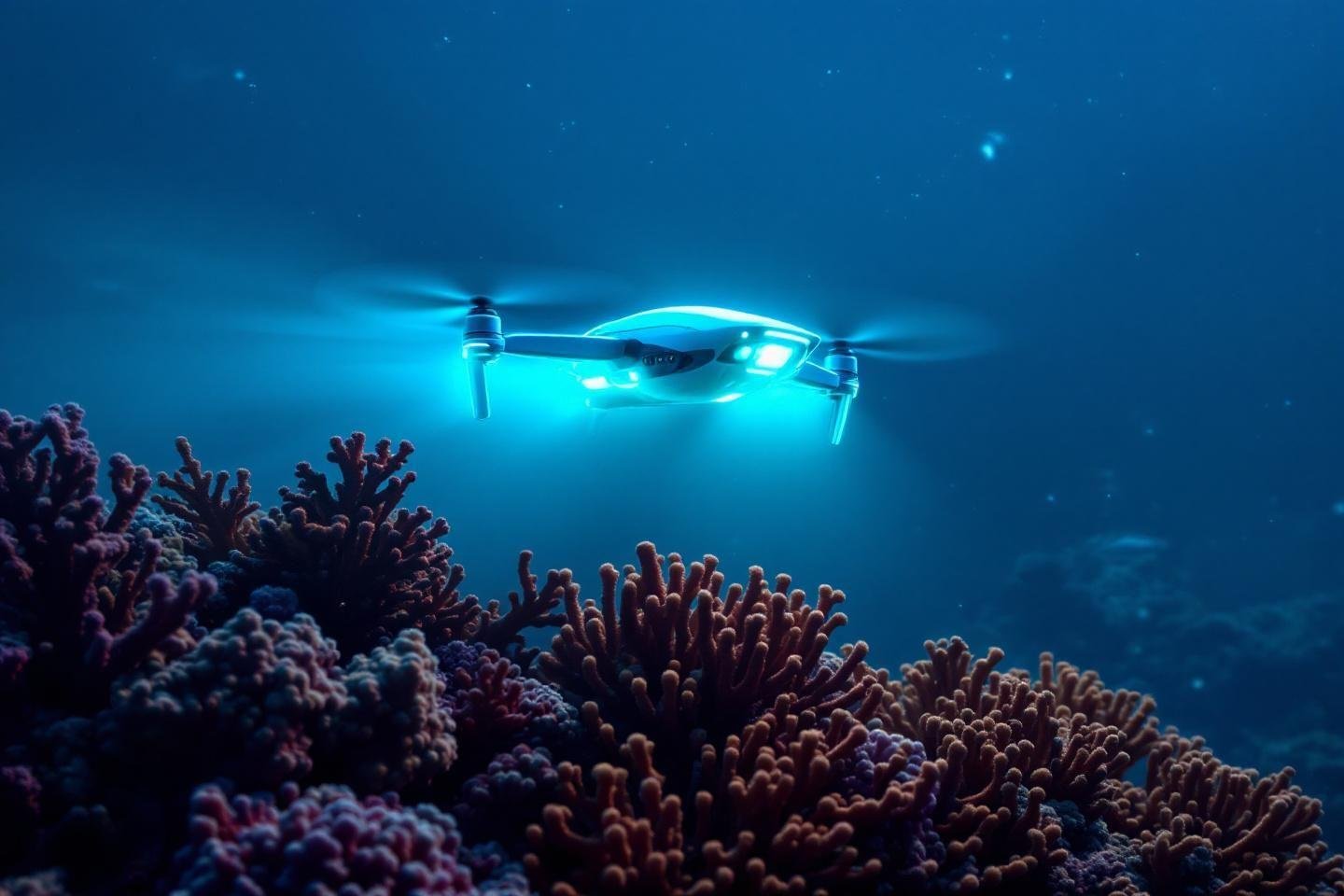
Centuries have passed since Ferdinand Magellan’s legendary maritime voyage, yet humanity’s spirit of exploration continues to thrive in unexpected ways. Today, this pioneering legacy finds its technological successor in Redwing, an autonomous underwater glider designed to accomplish something unprecedented beneath ocean waves. This revolutionary device promises to complete the first robotic circumnavigation of our planet underwater, demonstrating how far engineering capabilities have advanced since those earliest seafaring expeditions.
Developed through collaboration between Teledyne Marine and Rutgers University scientists, this remarkable vehicle stretches merely 2.57 meters while tipping scales at 171 kilograms. Its compact dimensions belie extraordinary ambitions : traversing 73,000 kilometers across five years while gathering oceanographic data from depths approaching 1,000 meters. The mission launches from Martha’s Vineyard on October 11, 2025, marking a transformative moment in marine robotics and scientific data collection.
Innovative design transforms underwater mobility
Traditional submarines rely on mechanical propulsion systems, but Redwing employs a fundamentally different approach. Its buoyancy-driven locomotion eliminates conventional propellers and engines entirely, creating a paradigm shift for autonomous maritime navigation. An internal piston mechanism alternates between compressing and expanding gas chambers, making the glider denser or lighter than surrounding water.
This ingenious system produces a distinctive sawtooth motion pattern : the vehicle descends gracefully toward maximum operational depth before ascending slowly through upper water columns. These continuous vertical oscillations generate forward momentum at approximately 0.75 knots, equivalent to 1.3 kilometers hourly. Small auxiliary propellers remain available for directional adjustments, though engineers anticipate minimal usage throughout the expedition.
The silent, fuel-free operation represents environmental stewardship through design. By eliminating mechanical noise, Redwing minimizes disturbance to marine ecosystems while harnessing ocean currents like an underwater sailing vessel. This approach demonstrates how contemporary robotics can collaborate with natural forces rather than overwhelming them, establishing new standards for sustainable scientific exploration beneath the surface.
Extended operational capabilities through strategic planning
Ocean gliders emerged during the 1990s, yet none attempted such ambitious multi-year journeys previously. Redwing’s oversized battery systems, carefully integrated within its streamlined hull, provide extraordinary operational longevity. Engineers calculate nearly two years of continuous operation before requiring scheduled mid-journey energy module replacement, ensuring mission continuity across vast oceanic expanses.
Daily communication protocols maintain operational oversight through satellite connections. The vehicle surfaces twice daily, transmitting collected data while receiving updated navigation instructions from the Teledyne Webb Research team and Rutgers University students. This methodical approach transforms potential recklessness into precise scientific methodology, building upon decades of autonomous underwater achievements :
- Scarlet Knight RU27 completed the first Atlantic crossing during 2009, requiring 221 days
- Silbo glider traversed 6,000 kilometers transatlantically throughout 2011
- PacX Wave Glider achieved 16,000 kilometers using solar power across Pacific waters in 2012
- Deepglider missions explored depths exceeding 6,000 meters during 2018 operations
Each previous mission progressively extended operational limits, establishing foundations for Redwing’s unprecedented circumnavigation attempt. The technological evolution from early Atlantic crossings to this global underwater expedition reflects accelerating capabilities in autonomous maritime systems.
| Vehicle name | Year | Distance | Duration | Notable achievement |
|---|---|---|---|---|
| Scarlet Knight RU27 | 2009 | 5,800 km | 221 days | First autonomous Atlantic crossing |
| Silbo | 2011 | 6,000 km | 7 months | Azores to Caribbean traverse |
| PacX Wave Glider | 2012 | 16,000 km | 15 months | Longest wave-powered journey |
| Redwing | 2025 | 73,000 km | 5 years | First underwater world circumnavigation |
Scientific value transcends technological demonstration
Redwing’s carefully planned trajectory mirrors Magellan’s historic route, traversing the Canary Islands, Cape of Good Hope, western Australia, New Zealand, Falkland Islands, potentially Brazilian waters, before returning toward Cape Cod. This path holds profound scientific importance beyond symbolic significance, as these oceanic regions remain poorly understood regarding temperature variations, salinity levels, and current patterns.
The mission represents the most extensive oceanic sampling expedition ever attempted by autonomous systems. Continuous data collection will provide climatologists and oceanographers with invaluable insights into global ocean circulation systems. While underwater exploration reveals prehistoric discoveries that reshape our understanding, Redwing focuses on contemporary oceanographic phenomena affecting climate patterns.
The vehicle will collect millions of data points on water temperature, density, and current velocity across previously unexplored maritime regions. This information, shared in real-time with educational institutions worldwide, will enhance understanding of ocean-climate interactions crucial for addressing global warming. NASA scientists mapping ocean floors have identified nearly 100,000 underwater mountains, highlighting vast knowledge gaps about our planet’s submerged landscape.
Navigating hazards throughout the expedition
Natural challenges pose significant risks to mission success. Fishing nets, commercial shipping traffic, curious sharks, and biofouling organisms threaten operational integrity. Marine biologists particularly worry about algae, barnacles, and microorganisms adhering to the hull, potentially weighing down the glider beyond operational limits that would compromise its buoyancy-driven propulsion system.
Underwater volcanic activity adds another complexity layer to deep-ocean navigation through geologically active regions. Each successful operational day validates autonomous underwater technology’s potential for extended scientific missions. This patient, methodical exploration approach embodies humanity’s persistent drive to push technological boundaries while deepening understanding of Earth’s most mysterious frontier beneath the waves.
The project embodies sustainable science principles : patient, economical, and environmentally conscious. Unlike fuel-consuming research vessels requiring large crews, this glider operates independently, powered by physics and precision instrumentation. Such autonomous oceanographic platforms represent the future of marine research, minimizing human environmental impact while maximizing scientific return through continuous data collection across unprecedented distances and timeframes.