
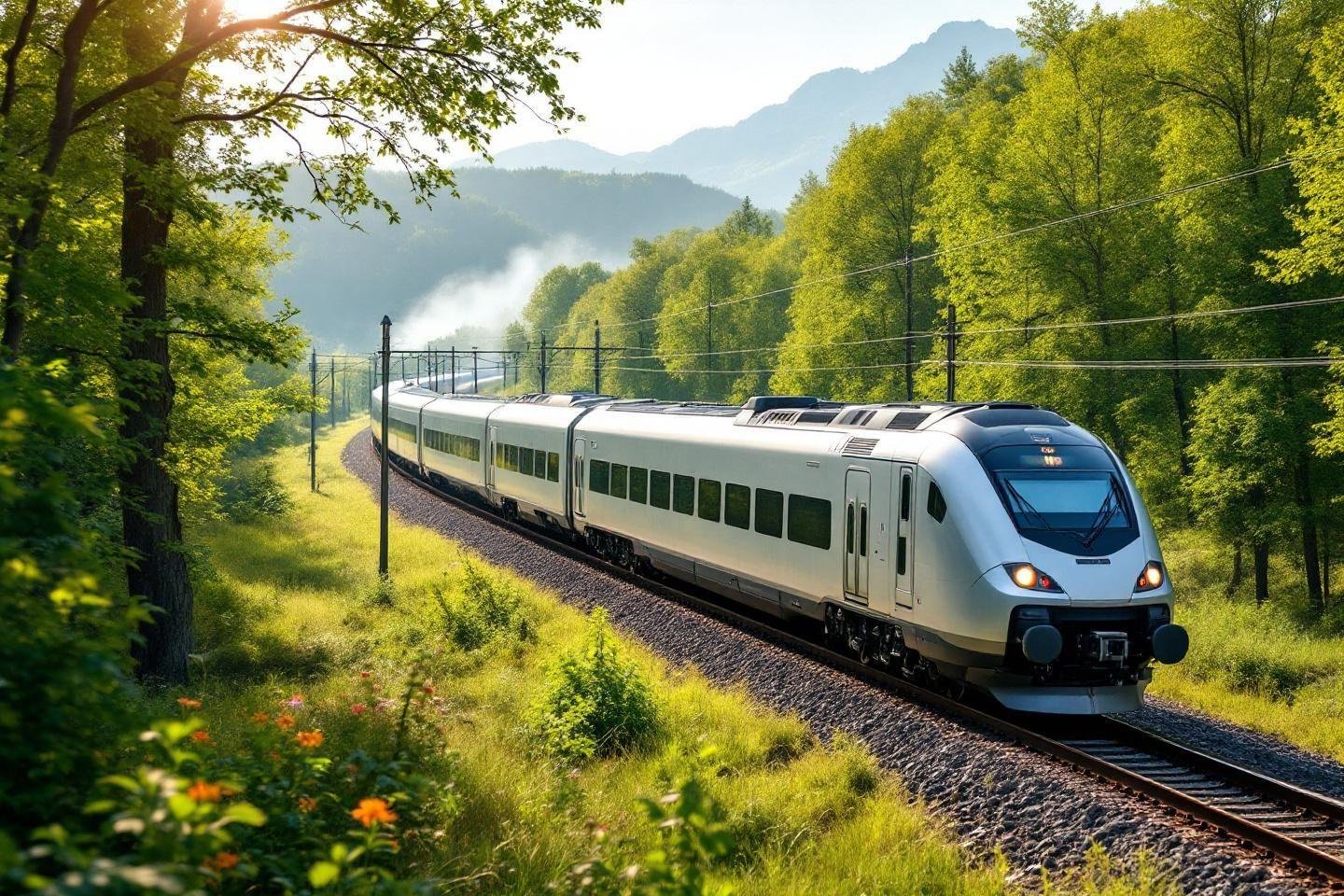
The transformation of intercity travel in China represents one of the most striking examples of how modern rail infrastructure can fundamentally reshape transportation economics. Between two of Asia’s most significant urban centers, a railway network has achieved what many transportation experts considered unattainable : making air travel economically unviable on a route spanning over 800 miles. This shift demonstrates how technological advancement combined with strategic planning can alter established travel patterns and challenge the dominance of aviation in medium to long-distance corridors.
La domination ferroviaire sur le corridor Beijing-Shanghai
The rail connection linking China’s capital to its financial hub has become a remarkable case study in transportation modal shift. Spanning approximately 1,300 kilometers, this corridor now sees rail transport capturing an overwhelming share of passenger traffic. The statistics paint a vivid picture of this dominance : in 2024, railways carried 52 million travelers while airlines struggled with just 8.6 million passengers.
This six-to-one ratio in favor of trains reveals a complete reversal of traditional travel preferences. The financial performance of the railway operation further underscores its success, with revenues reaching 42 billion yuan, equivalent to roughly 5.4 billion euros, and generating net profits exceeding 1.8 billion dollars. Such profitability on a single route demonstrates the economic viability of high-speed rail when properly implemented and scaled.
What makes this achievement particularly noteworthy is the demographic shift it represents. Even affluent business travelers, traditionally loyal to air transport for its perceived speed and prestige, have embraced rail as their preferred mode of transportation. This behavioral change among premium passengers signals a fundamental reassessment of what constitutes optimal travel for business and leisure purposes.
Les facteurs clés du succès ferroviaire chinois
Several interconnected elements explain why trains have achieved such comprehensive victory over planes on this strategic route. Speed remains the most obvious advantage, with modern Chinese trains completing the journey in just 4 hours and 18 minutes at their fastest. Even services with intermediate stops manage to cover the distance in under 8 hours, maintaining competitive timing while serving additional markets.
Frequency provides another crucial advantage that airlines struggle to match. With 100 daily departures on this single line, passengers enjoy unprecedented flexibility in scheduling their trips. This high-frequency service eliminates the need for advance planning and allows travelers to adapt their schedules with minimal constraints.
| Critère de comparaison | Train à grande vitesse | Transport aérien |
|---|---|---|
| Durée du trajet | 4h18 à 8h | 2h30 vol + attentes |
| Fréquence quotidienne | 100 services | 55 vols |
| Connectivité internet | Continue | Limitée ou absente |
| Localisation terminaux | Centre-ville | Périphérie urbaine |
Digital connectivity throughout the journey has emerged as a decisive competitive advantage. Unlike air passengers who must disconnect during flight, train travelers maintain constant internet access, enabling them to work, communicate, and stay productive. This capability became a national infrastructure priority following the Beijing Winter Olympics, reflecting China’s understanding of modern professional needs.
Practical considerations further tilt the balance toward rail. The following advantages compound to create a superior travel experience :
- Central station locations eliminate lengthy transfers to and from airports
- Exceptional punctuality reduces schedule uncertainty and stress
- Minimal check-in requirements save time compared to aviation security procedures
- Premium onboard amenities rival or exceed business class airline offerings
La riposte désespérée de l’industrie aérienne
Chinese airlines find themselves in an unprecedented predicament. Major carriers including Air China and China Eastern Airlines have attempted collaborative strategies to stem passenger losses, yet their combined 55 daily flights struggle to remain commercially viable. The airlines’ situation illustrates how established industries can be disrupted when a superior alternative emerges in the marketplace.
Desperate to recapture market share, airlines have introduced enhanced services such as limousine transfers to urban centers and flexible scheduling options. However, these improvements cannot overcome inherent structural disadvantages : mandatory early check-ins, security screening delays, and the absence of continuous connectivity during flight. Even aggressive price reductions have proven insufficient to reverse the migration toward rail.
L’excellence technologique au service de la mobilité
The CR450AF represents the pinnacle of China’s railway technological advancement, designed to operate at speeds reaching 450 kilometers per hour. While current infrastructure limits commercial operations to 350 km/h, plans to upgrade tracks for 400 km/h operation by 2027 demonstrate ongoing commitment to performance enhancement. This continuous innovation cycle ensures rail maintains its competitive edge.
China’s high-speed network extends far beyond this single corridor, constituting the world’s most extensive system. The country has surpassed traditional railway powers including France, Japan, and Spain, which ranks second globally, in total network length and technological sophistication. This national infrastructure achievement positions China as the global leader in modern rail transport.
Not every route replicates the Beijing-Shanghai success story. Several domestic lines experience lower passenger volumes and operate at financial losses, demonstrating that high-speed rail succeeds best on high-density corridors connecting major population centers. Nevertheless, where conditions align favorably, rail supremacy appears unassailable. While European nations struggle with network harmonization, pricing competitiveness against budget airlines, and intermodal integration, the Chinese example offers valuable lessons in how efficiency, frequency, speed, and connectivity can fundamentally transform transportation landscapes.